Con Law for 1Ls: Gonzales v. Raich Explained


If Lopez and Morrison tell you that the Commerce Clause has limits, Gonzales v. Raich tells you something equally important:
Congress still has very broad authority when it regulates economic markets comprehensively.
That is why Gonzales v. Raich, 545 U.S. 1 (2005) is one of the key modern federal power cases every 1L should know. It holds that Congress could apply the federal Controlled
Substances Act to locally grown and locally used medical marijuana, even when state law allowed that use.
This post is part of a Con Law for 1Ls series, so the goal is to make the case clear enough for class, cold calls, outlines, and exams.
The One-Sentence Takeaway
Gonzales v. Raich held that Congress may regulate even local, noncommercial cultivation and possession of marijuana when doing so is part of a comprehensive federal scheme regulating the interstate market in controlled substances.
That is the short version to remember.
Why Your Professor Cares About Raich
Your professor is not assigning Raich because of marijuana policy. The real reason is that
the case helps answer a major follow-up question after Lopez and Morrison:
If Congress cannot regulate every local non-economic activity, when can it still reach local conduct under the Commerce Clause?
Raich gives the answer:
When the local conduct is part of a class of activity that Congress may regulate as part of a comprehensive economic scheme.
That makes Raich one of the most important Commerce Clause reconciliation cases in modern Con Law.
The Facts You Actually Need to Know
Here is the short 1L version.
California had adopted the Compassionate Use Act, allowing the medical use of marijuana under state law.
Two California residents, Angel Raich and Diane Monson, used marijuana for medical purposes in compliance with state law. Monson also grew marijuana at home for her own use.
Federal agents destroyed Monson’s marijuana plants under the federal Controlled Substances Act (CSA), which prohibits marijuana possession and cultivation.
Raich and Monson argued that applying the federal law to their purely local, medically authorized conduct exceeded Congress’s power under the Commerce Clause.
The Supreme Court disagreed.
The Big Question
The main issue was:
Can Congress, under the Commerce Clause, prohibit the local cultivation and possession of marijuana for personal medical use when that conduct is authorized by state law and does not involve sale or interstate movement?
The Supreme Court said yes.
The Holding
Here is the clean holding:
Congress may apply the Controlled Substances Act to intrastate cultivation and possession of marijuana for medical use because that activity is part of a class of economic activity that substantially affects interstate commerce. See Gonzales v. Raich.
That is the core doctrine.
Why Raich Looks Different from Lopez and Morrison
This is the first thing your professor probably wants you to understand.
At first glance, Raich can seem inconsistent with Lopez and Morrison.
After all:
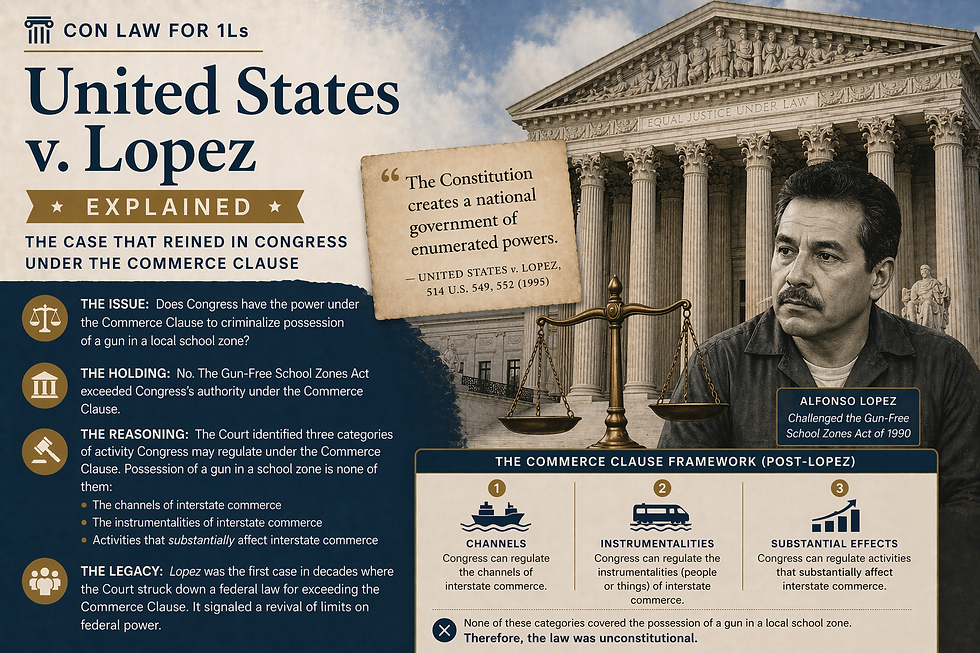
In Lopez, the Court struck down a federal law regulating local gun possession.
In Morrison, the Court struck down a federal law creating a civil remedy for gender-motivated violence.
In Raich, the Court upholds federal regulation of local marijuana cultivation and possession.
So what is the difference?
The answer:
The Court saw the activity in Raich as connected to a comprehensive regulation of an interstate economic market.
That is the crucial distinction.
The Role of Wickard v. Filburn
To understand Raich, you really need to understand its relationship to Wickard v. Filburn.
In Wickard, the Court upheld federal limits on wheat grown at home for personal consumption because even homegrown wheat, when aggregated across many actors, could affect the national wheat market.
Raich applies that same logic.
The Court said that even marijuana grown at home for personal medical use could, in the aggregate, affect the interstate market in marijuana and undermine Congress’s broader regulatory scheme.
So in many ways, Raich is a modern Wickard case.
The Key Point: Comprehensive Regulatory Scheme
This is the heart of the opinion.
The federal government was not trying to regulate homegrown medical marijuana in isolation. It was enforcing the Controlled Substances Act, which is a broad national framework designed to control the interstate drug market.
The Court reasoned that if local cultivation and possession were exempted, that would create a gap in the broader federal scheme.
And Congress can regulate local activity when doing so is necessary to make a larger economic regulatory program effective. See Raich.
That is why the case matters so much.
The Key Rule in 1L Terms
Here is the exam-friendly version:
Congress may regulate even intrastate, noncommercial activity when that activity is part of a broader class of economic activity and regulation of the local conduct is necessary to support a comprehensive federal scheme governing an interstate market.
That is the Raich rule most 1Ls should know.
Why the Court Treated the Activity as Economic Enough
This is where students sometimes get confused.
The respondents argued that their conduct was:
local,
noncommercial,
medically necessary,
and authorized by state law.
All of that was true in one sense.
But the Court focused on the broader regulated category:
the production,
possession,
and distribution of marijuana
as part of a market that Congress chose to regulate comprehensively.
So even if one person’s conduct looked noncommercial in isolation, Congress could still reach it as part of a broader economic class of activity.
That is pure aggregation reasoning.
The Necessary and Proper Logic in the Case
Even though the case is taught mostly as a Commerce Clause case, there is also a strong Necessary and Proper Clause flavor to the reasoning.
The Court was essentially saying:
Congress may regulate the interstate drug market.
To make that scheme effective, Congress may also regulate local instances that could undermine it.
Otherwise, the federal program would have a major enforcement gap.
So Raich is one of those cases where the Commerce Clause and Necessary and Proper logic work closely together.
The Cold-Call Version
If your professor asks, “What is Gonzales v. Raich about?” you can say:
Gonzales v. Raich held that Congress could apply the Controlled Substances Act to local cultivation and possession of medical marijuana because that conduct was part of a broader class of activity affecting the interstate drug market, and regulating it was necessary to make the federal scheme effective.
That is a strong cold-call answer.
Why Raich Does Not Erase Lopez and Morrison
This is the key nuance.
Raich does not overrule Lopez or Morrison.
Instead, it distinguishes them.
Lopez and Morrison involved:
non-economic activity
regulated in a more isolated way
without the same kind of comprehensive market scheme
Raich involved:
regulation tied to a broader national economic market
within a comprehensive statutory framework
using aggregation reasoning similar to Wickard
So the better way to think about these cases is:
Lopez and Morrison = meaningful limits remain
Raich = but Congress still has broad power when regulating a national economic market comprehensively
That is the reconciliation.
Common 1L Mistakes About Raich
Mistake #1: Thinking Raich says Congress can regulate anything local
Not quite. The case depends heavily on the existence of a comprehensive federal economic scheme.
Mistake #2: Thinking Raich overruled Lopez
It did not. It distinguished Lopez and applied a different logic.
Mistake #3: Focusing too much on state marijuana policy
The state law background matters factually, but the real doctrinal issue is the reach of federal power under the Commerce Clause.
Mistake #4: Forgetting Wickard
Raich makes much more sense if you see it as a Wickard case.
Quick IRAC for Your Outline
Issue
Could Congress apply the Controlled Substances Act to the local cultivation and possession of marijuana for personal medical use authorized by state law?
Rule
Congress may regulate intrastate activity when it is part of a broader class of economic activity that substantially affects interstate commerce, especially where such regulation is necessary to support a comprehensive federal regulatory scheme. See Raich.
Application
The Controlled Substances Act comprehensively regulates the interstate drug market. Local cultivation and possession of marijuana, even for personal medical use, could affect that market in the aggregate and create a gap in the federal scheme if left unregulated.
Conclusion
Application of the CSA was constitutional.
What to Put in Your Case Brief
If you are briefing Raich for class, include:
Facts: California allowed medical marijuana; federal law prohibited it
Issue: could Congress regulate local medical marijuana under the Commerce Clause?
Holding: yes
Reasoning: local conduct was part of a broader regulable economic class; regulation was necessary to an integrated federal scheme
Key doctrine: aggregation + comprehensive regulatory scheme
Connection to Wickard: strong
Connection to Lopez/Morrison: distinguished, not overruled
That is enough for most 1L purposes.
Why Raich Still Matters Today
Raich is still one of the key modern Commerce Clause cases because it shows how broad federal power can remain even after Lopez and Morrison.
It is especially important whenever Congress is regulating:
a nationwide market,
a comprehensive statutory scheme,
or local conduct that might undermine a broader federal program.
Later cases and lower courts continue to use Raich when thinking about the relationship between local conduct and national regulation. See, for example, Taylor v. United States, 136 S. Ct. 2074 (2016), discussing Congress’s power over the marijuana market.
How Raich Fits with Lopez and Morrison
This is the modern Commerce Clause sequence your outline should probably capture:
Lopez: Congress cannot regulate non-economic local gun possession based on a remote theory of commerce effects.
Morrison: Congress also cannot regulate non-economic gender-motivated violence based on aggregate effects.
Raich: But Congress can regulate local activity when it is part of a broader class of economic activity within a comprehensive national market regulation scheme.
That is a very useful 1L framework.
Final Takeaway for 1Ls
If you remember nothing else, remember this:
Gonzales v. Raich says that even local, noncommercial conduct can fall within
Congress’s commerce power when regulating that conduct is necessary to make a broader federal economic regulatory scheme effective.
That is why the case matters so much.
The medical marijuana was the vehicle.The real subject was how far Congress can go when regulating a national market comprehensively.
And that is why Gonzales v. Raich, 545 U.S. 1 (2005) is one of the core Con Law cases every 1L should know.

Comments