Con Law for 1Ls: Reynolds v. Sims Explained

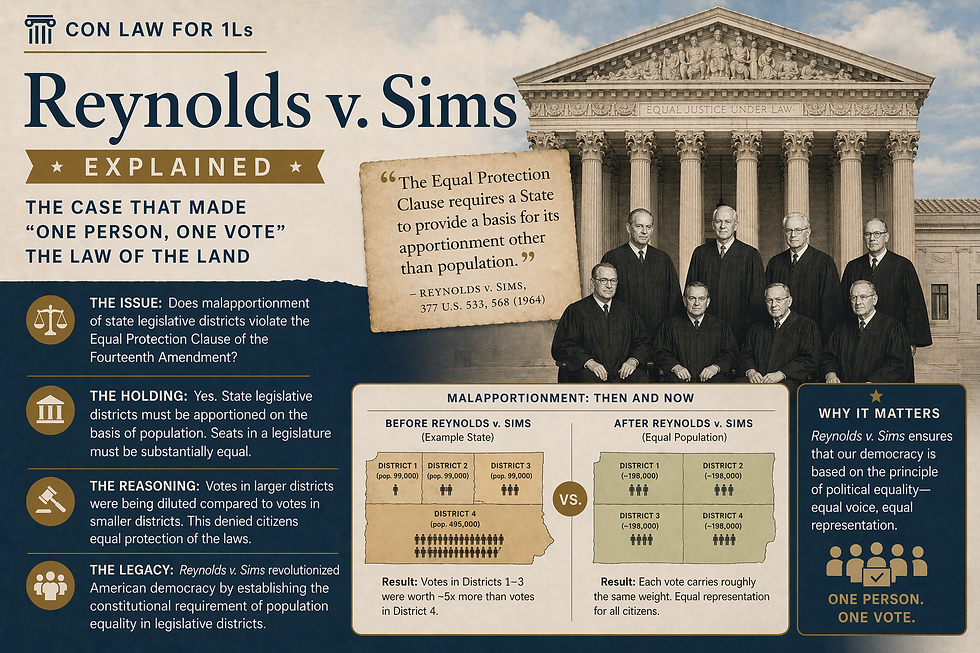
If Baker v. Carr opened the courthouse door to reapportionment claims, Reynolds v. Sims told courts what the Constitution requires once they get inside.
The basic answer is the phrase every 1L eventually memorizes:
one person, one vote.
That is why Reynolds v. Sims, 377 U.S. 533 (1964) is one of the most important Equal Protection and voting-rights cases in Constitutional Law. It held that seats in both houses of a state legislature must be apportioned on a population basis so that each person’s vote is weighted as equally as practicable.
This post is part of a Con Law for 1Ls series, so the goal is to make the case clear enough for class, cold calls, outlines, and exams.
The One-Sentence Takeaway
Reynolds v. Sims held that the Equal Protection Clause requires both houses of a state legislature to be apportioned substantially on a population basis, giving rise to the “one person, one vote” principle.
That is the clean short version.
Why Your Professor Cares About Reynolds
Your professor is not assigning Reynolds just because Alabama’s maps were old. The real reason is that the case answers the next big question after Baker:
If reapportionment claims are justiciable, what does the Constitution actually require?
The Court’s answer was:
Legislators represent people, not trees, acres, or counties.
That is the central idea of the case.
So Reynolds matters because it establishes the modern constitutional rule for state legislative apportionment under the Equal Protection Clause.
The Facts You Actually Need to Know
Here is the short 1L version.
Alabama’s legislative districts had become wildly unequal in population, but the state had failed to reapportion as population changed.
That meant some districts with small populations elected the same number of representatives as districts with much larger populations.
The result was severe vote dilution.
Voters challenged the scheme under the Equal Protection Clause of the Fourteenth Amendment.
The Supreme Court agreed that the apportionment system was unconstitutional.
The Big Question
The main issue was:
Does the Equal Protection Clause require both houses of a state legislature to be apportioned substantially by population, so that votes are weighted equally?
The Supreme Court said yes.
The Holding
Here is the clean holding:
The Equal Protection Clause requires that seats in both houses of a bicameral state legislature be apportioned on a population basis, so that each citizen’s vote is given substantially equal weight. See Reynolds v. Sims.
That is the core doctrine.
How Reynolds Builds on Baker
This is the key connection your professor probably wants you to see.
Baker said:
A reapportionment claim under the Equal Protection Clause is justiciable.
Reynolds said:
And on the merits, the Constitution requires substantial population equality in state legislative districts.
So if Baker is the can courts hear this? case, Reynolds is the what is the constitutional rule? case.
That is why they are almost always taught together.
The Core Principle: One Person, One Vote
This is the phrase you need to know.
The Court reasoned that when districts are radically unequal in population, voters in smaller districts have disproportionately greater political power than voters in larger districts.
That violates the Equal Protection Clause because the weight of a person’s vote should not depend on where that person lives. See Reynolds.
The resulting principle is usually summarized as:
one person, one vote
That is not a magic phrase in the Constitution, but it is the doctrine the case is known for.
Why Both Houses Matter
A major argument against the plaintiffs was that maybe only one house of the state legislature needed to reflect population, while the other could be based on geographic or political subdivisions.
The Court rejected that.
This is one of the most testable points in the case.
The Court said that both houses of a bicameral state legislature must be apportioned substantially by population.
States could not copy the federal model by having one chamber represent population and the other represent counties or regions instead. See Reynolds.
Why the Federal Senate Analogy Fails
This is another classic exam point.
Some argued that if the U.S. Congress can have:
a House based on population, and
a Senate giving equal representation to states,
then state legislatures should be allowed to copy that model.
The Court rejected that analogy.
Why?
Because the federal Senate was the result of a unique constitutional compromise among sovereign states entering the Union. State counties are not equivalent to sovereign states in that constitutional sense.
So the special structure of the federal government does not justify malapportionment in state legislatures.
That is a very important distinction.
The Key Rule in 1L Terms
Here is the exam-friendly version:
Under Reynolds v. Sims, the Equal Protection Clause requires substantially equal population in state legislative districts so that each person’s vote is worth roughly the same as every other person’s vote.
That is the clean rule for your outline.
The Court’s Basic Reasoning
1. Voting is a fundamental constitutional interest
The Court treated the right to participate equally in elections as central to representative government.
2. Diluting votes by malapportionment is constitutionally serious
When voters in one district have much more representation per person than voters in another district, the state is effectively weighting some votes more heavily than others.
3. Equal Protection applies to representation
The Court reasoned that equal protection requires substantial equality in the weight of votes.
4. Geography alone cannot justify major disparities
States may consider some practical factors in districting, but they cannot use geography or political subdivision lines to create major population inequality in representation.
See Reynolds.
What “Substantially Equal” Means
This part matters.
The Court did not say districts must be mathematically perfect in every situation.
Instead, it required substantial equality of population.
That means minor deviations may sometimes be tolerated, but large disparities that systematically overvalue some votes and undervalue others are unconstitutional.
For 1L purposes, the main thing to remember is not the precise later doctrine on allowable deviations. It is the principle that population equality is the constitutional baseline for state legislative apportionment.
The Cold-Call Version
If your professor asks, “What is Reynolds v. Sims about?” you can say:
Reynolds v. Sims held that the Equal Protection Clause requires both houses of a state legislature to be apportioned substantially by population, establishing the one person, one vote principle for state legislative districts.
That is a strong cold-call answer.
Why This Case Was So Important
Reynolds transformed American politics.
Before it, many state legislatures were severely malapportioned, often overrepresenting rural areas and underrepresenting urban populations.
After Reynolds, states had to redraw legislative districts to reflect population much more closely.
So this is not just a doctrinal case. It is one of the cases that changed how American representative democracy functions.
Common 1L Mistakes About Reynolds
Mistake #1: Thinking Baker and Reynolds are the same case
They are closely connected, but they do different jobs:
Baker = justiciability
Reynolds = substantive rule
Mistake #2: Thinking only one legislative chamber must follow population equality
Wrong. Reynolds says both houses of a bicameral state legislature must be apportioned substantially by population.
Mistake #3: Assuming the federal Senate analogy works
It does not. The Court specifically rejects using the U.S. Senate as a model for state apportionment.
Mistake #4: Thinking the Constitution demands perfect mathematical equality in all contexts
The case requires substantial equality, not literal perfection in every instance.
Quick IRAC for Your Outline
Issue
Does the Equal Protection Clause require both houses of a state legislature to be apportioned substantially according to population?
Rule
Under Reynolds v. Sims, state legislative districts in both houses of a bicameral legislature must be apportioned substantially on a population basis so that votes are weighted equally. See Reynolds.
Application
Alabama’s legislative apportionment created major population disparities among districts, meaning some citizens’ votes carried much greater weight than others. That dilution of voting strength violated the Equal Protection Clause.
Conclusion
The apportionment system was unconstitutional.
What to Put in Your Case Brief
If you are briefing Reynolds for class, include:
Facts: Alabama had malapportioned legislative districts with large population disparities
Issue: does equal protection require population-based apportionment in both legislative houses?
Holding: yes
Reasoning: vote dilution violates equal protection; legislators represent people, not geographic units
Key doctrine: one person, one vote
Connection to Baker: Baker made the claim justiciable; Reynolds decided the merits
That is enough for most 1L purposes.
Why Reynolds Still Matters Today
Reynolds remains foundational because population equality is still a central constitutional principle in state legislative districting.
Even when later cases deal with gerrymandering, district deviations, or election administration, the baseline idea that representation must reflect population remains one of the bedrock rules of election law.
So Reynolds is still very much alive in modern constitutional doctrine.
How Reynolds Fits with the Earlier Cases
By this point, the series has a nice arc:
Marbury: courts interpret the Constitution
McCulloch: federal power can be broad
Martin and Cohens: the Supreme Court has final authority over federal questions
Gibbons: Congress’s commerce power is broad
Cooper: states must obey Supreme Court constitutional rulings
Youngstown: presidential power has limits
Baker: reapportionment claims are justiciable
Reynolds: equal protection requires one person, one vote in state legislative apportionment
That makes Reynolds one of the key democracy-structure cases in Con Law.
Final Takeaway for 1Ls
If you remember nothing else, remember this:
Reynolds v. Sims says that state legislatures must be apportioned by population because the Constitution does not allow some citizens’ votes to count much more than others simply because of where they live.
That is why the case matters so much.
The Alabama districts were the vehicle.The real subject was political equality in representative government.
And that is why Reynolds v. Sims, 377 U.S. 533 (1964) is one of the core Con Law cases every 1L should know.


Comments