Con Law for 1Ls: United States v. Morrison Explained


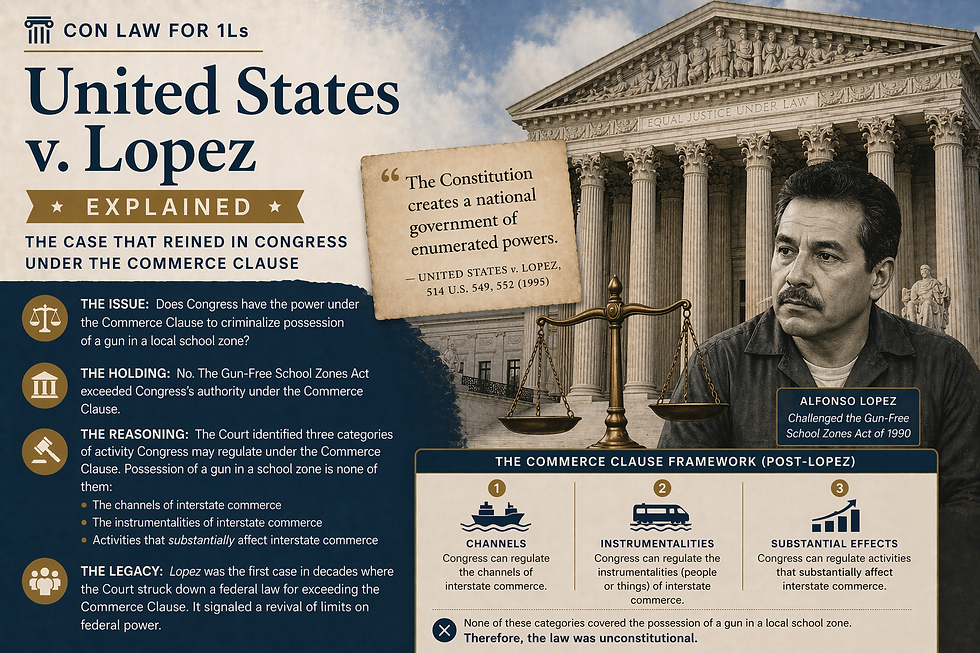
If United States v. Lopez says that Congress cannot regulate every local non-economic activity under the Commerce Clause, United States v. Morrison says the same basic thing again — and then adds:
Congress also cannot use Section 5 of the Fourteenth Amendment to regulate purely private conduct in this setting.
That is why United States v. Morrison, 529 U.S. 598 (2000) is one of the most important follow-up cases to Lopez. It is a major federalism case because it limits both:
the Commerce Clause, and
Congress’s enforcement power under Section 5 of the Fourteenth Amendment
This post is part of a Con Law for 1Ls series, so the goal is to make the case clear enough for class, cold calls, outlines, and exams.
The One-Sentence Takeaway
United States v. Morrison held that Congress lacked power under both the Commerce Clause and Section 5 of the Fourteenth Amendment to create a federal civil remedy for victims of gender-motivated violence.
That is the short version you want to remember.
Why Your Professor Cares About Morrison
Your professor is not assigning Morrison just because it involves the Violence Against Women Act. The real reason is that the case asks two huge constitutional questions:
How far can Congress go under the Commerce Clause when regulating non-economic activity?
How far can Congress go under Section 5 of the Fourteenth Amendment when trying to remedy private misconduct?
The Supreme Court answered both questions narrowly.
That makes Morrison a very important case for understanding modern limits on federal power.
The Facts You Actually Need to Know
Here is the short 1L version.
A Virginia Tech student, Christy Brzonkala, alleged that she had been sexually assaulted by two fellow students.
She sued under a provision of the Violence Against Women Act (VAWA) that created a federal civil cause of action for victims of gender-motivated violence.
The question was whether Congress had constitutional authority to create that federal remedy.
The Supreme Court said no.
The Big Question
The case involved two main issues:
1. Commerce Clause
Could Congress create a federal civil remedy for gender-motivated violence under its power to regulate interstate commerce?
2. Section 5 of the Fourteenth Amendment
Could Congress justify the remedy as legislation enforcing the Equal Protection Clause?
The Supreme Court said no on both.
The Holding
Here is the clean holding:
The civil remedy provision of the Violence Against Women Act exceeded Congress’s authority under both the Commerce Clause and Section 5 of the Fourteenth Amendment. See United States v. Morrison.
That is the core doctrine.
Part One: The Commerce Clause Analysis
This is where Morrison connects directly to Lopez.
What Congress tried to regulate
The statute created a civil remedy for victims of gender-motivated violence.
The Court treated that conduct as non-economic, violent criminal conduct.
That mattered a lot.
Why the Court struck it down
The Court said Congress could not regulate this conduct under the Commerce Clause merely by arguing that gender-motivated violence has serious aggregate effects on the national economy.
Congress had compiled extensive findings about how violence against women affects employment, health care costs, productivity, and interstate economic participation.
But the Court said that was still not enough.
Why?
Because if Congress could regulate non-economic violent conduct simply by showing aggregate economic effects, then federal power would become essentially unlimited.
That is the same structural concern that drove Lopez.
See Morrison.
Why Morrison Follows Lopez
This is the key connection your professor probably wants you to see.
Lopez said:
Congress cannot regulate non-economic local activity through an overly attenuated chain of effects on commerce.
Morrison said:
That logic also applies here. Gender-motivated violence, however serious, is still non-economic conduct, and Congress cannot convert it into commerce regulation by stacking inference upon inference.
So Morrison reinforces Lopez.
The Key Commerce Clause Point
The biggest doctrinal takeaway is this:
Congress may not regulate purely non-economic violent criminal conduct based solely on its aggregate effect on interstate commerce.
That is the heart of the Commerce Clause part of Morrison.
What About Congressional Findings?
This is an important nuance.
Congress had made a detailed factual record showing that gender-motivated violence has major economic consequences.
But the Court said congressional findings do not automatically save a statute if the underlying activity is beyond the commerce power.
That is a very testable point.
So for 1Ls:
Findings can help
but findings are not magic
The Court still asks whether the regulated activity is the kind of thing Congress may regulate under the Commerce Clause.
Part Two: The Section 5 Analysis
This is what makes Morrison especially important.
The government also argued that Congress could enact the civil remedy under Section 5 of the Fourteenth Amendment, which gives Congress power to enforce the Amendment’s guarantees.
The Court rejected that too.
Why?
Because the Fourteenth Amendment restricts state action, not purely private conduct.
The VAWA civil remedy targeted private individuals who committed gender-motivated violence.
That was the problem.
The Court said Congress may enforce the Fourteenth Amendment against state violations, but it may not use Section 5 to regulate private conduct that is not itself state action. See Morrison.
That is a huge point for exams.
The Key Section 5 Rule in 1L Terms
Here is the exam-friendly version:
Section 5 of the Fourteenth Amendment allows Congress to enforce the Amendment against state action, but it does not give Congress a general power to regulate purely private conduct.
That is the core Section 5 takeaway from Morrison.
The Key Rules You Should Know
Here are the two big doctrinal rules from the case:
Commerce Clause rule
Congress cannot regulate non-economic violent criminal conduct based solely on aggregate economic effects.
Section 5 rule
Congress cannot use Section 5 of the Fourteenth Amendment to create remedies against purely private conduct not attributable to the state.
If you know those two rules, you know the case.
The Cold-Call Version
If your professor asks, “What is United States v. Morrison about?” you can say:
United States v. Morrison held that Congress lacked power under the Commerce Clause to create a federal civil remedy for victims of gender-motivated violence because the statute regulated non-economic private conduct, and Congress also lacked authority under Section 5 because the Fourteenth Amendment targets state action, not purely private conduct.
That is a strong cold-call answer.
Why Morrison Matters for Federalism
At bottom, Morrison is another federalism case.
The Court was worried that if Congress could regulate gender-motivated violence under the Commerce Clause, then almost all traditionally local violent crime could become a federal matter.
And if Congress could use Section 5 to regulate private conduct directly, it would dramatically expand federal power beyond the state-action structure of the Fourteenth Amendment.
So the case draws constitutional boundaries around federal authority and leaves a large domain of criminal law and tort law to the states.
Common 1L Mistakes About Morrison
Mistake #1: Thinking the case says Congress can never regulate violence
Too broad. The holding is narrower: Congress could not regulate this non-economic
private violence under the theories offered here.
Mistake #2: Forgetting there are two separate holdings
This is very important. Morrison is both:
a Commerce Clause case, and
a Section 5 case.
Mistake #3: Thinking congressional findings solve everything
They do not. The Court still asks whether the subject matter is within Congress’s constitutional power.
Mistake #4: Missing the private conduct point
The Section 5 analysis turns on the distinction between:
state action, and
purely private conduct
That distinction is essential.
Quick IRAC for Your Outline
Issue
Could Congress create a federal civil remedy for victims of gender-motivated violence under the Commerce Clause or Section 5 of the Fourteenth Amendment?
Rule
Congress may not regulate non-economic private violence under the Commerce Clause based solely on aggregate economic effects, and Section 5 of the Fourteenth Amendment does not authorize Congress to regulate purely private conduct. See Morrison.
Application
The VAWA civil remedy targeted gender-motivated violence, which the Court treated as non-economic private conduct. Although Congress compiled extensive findings about the national economic effects of such violence, the conduct remained outside the commerce power as defined in Lopez. And because the statute regulated private actors rather than state action, Section 5 could not sustain it.
Conclusion
The statute was unconstitutional.
What to Put in Your Case Brief
If you are briefing Morrison for class, include:
Facts: VAWA created a federal civil remedy for victims of gender-motivated violence
Issue 1: did Congress have Commerce Clause power?
Issue 2: did Congress have Section 5 power?
Holding: no on both
Reasoning: non-economic private conduct is outside the commerce power here; Section 5 does not reach purely private conduct
Key doctrine: limits on both Commerce Clause and Section 5
That is enough for most 1L purposes.
How Morrison Fits with Lopez
The relationship is very straightforward:
Lopez: Congress cannot regulate non-economic local gun possession through an attenuated commerce theory.
Morrison: Congress also cannot regulate non-economic gender-motivated violence through an attenuated commerce theory.
So Morrison is often best understood as Lopez applied again, but in a new context and with a separate Section 5 discussion added on top.
Why Morrison Still Matters Today
Morrison remains important because it is one of the leading modern cases on the outer limits of Congress’s enumerated powers.
It still matters in debates about:
the Commerce Clause,
Section 5 enforcement power,
the state-action requirement,
and federalism more broadly.
It is also a key bridge case between Lopez and later decisions like Gonzales v. Raich and NFIB v. Sebelius.
How Morrison Fits with the Earlier Cases
By this point, the federal power sequence looks like this:
McCulloch: federal power can be broad
Gibbons: the commerce power can be broad
Lopez: there are limits on the commerce power
Morrison: those limits apply to non-economic private violence too, and Section 5 also has limits
That makes Morrison a major case in the modern federalism part of the course.
Final Takeaway for 1Ls
If you remember nothing else, remember this:
United States v. Morrison says that Congress cannot use the Commerce Clause to regulate every serious local problem with economic consequences, and it cannot use
Section 5 of the Fourteenth Amendment to regulate purely private conduct.
That is why the case matters so much.
The VAWA civil remedy was the vehicle.The real subject was the constitutional boundary of federal power.
And that is why United States v. Morrison, 529 U.S. 598 (2000) is one of the core Con Law cases every 1L should know.

Comments