Con Law for 1Ls: United States v. Lopez Explained

If Gibbons v. Ogden teaches that Congress’s commerce power can be broad, United States v. Lopez teaches the next major point:
The commerce power still has limits.
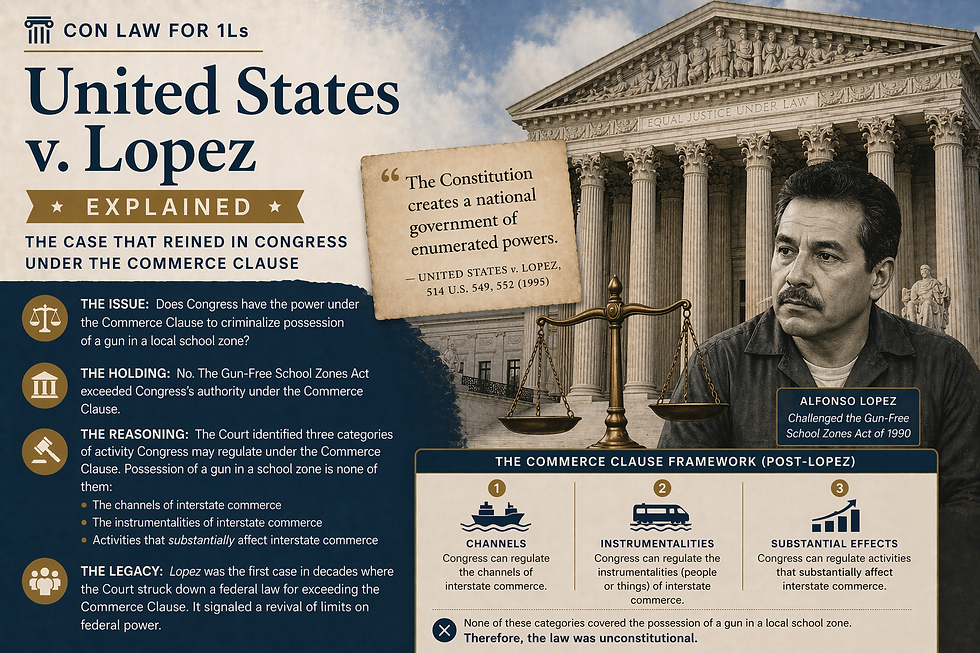
That is why United States v. Lopez, 514 U.S. 549 (1995) is one of the most important federal power cases in modern Constitutional Law. It was the first case in decades in which the Supreme Court struck down a federal statute as exceeding Congress’s power under the Commerce Clause.
This post is part of a Con Law for 1Ls series, so the goal is to make the case clear enough for class, cold calls, outlines, and exams.
The One-Sentence Takeaway
United States v. Lopez held that the Gun-Free School Zones Act exceeded Congress’s Commerce Clause power because mere possession of a gun in a local school zone was not economic activity sufficiently connected to interstate commerce.
That is the clean short version.
Why Your Professor Cares About Lopez
Your professor is not assigning Lopez because of one student carrying a gun. The real reason is that the case asks a huge structural question:
Are there judicially enforceable limits on Congress’s Commerce Clause power?
For much of the modern era, Congress’s commerce power had been read very broadly.
Lopez is important because it reminds everyone that the federal government is still one of enumerated powers, not a general police power.
That is the basic significance of the case.
The Facts You Actually Need to Know
Here is the short 1L version.
A high school student, Alfonso Lopez, brought a handgun to school in San Antonio, Texas.
He was charged under the Gun-Free School Zones Act of 1990, a federal law making it a crime to possess a firearm in a school zone.
Lopez argued that Congress lacked power under the Commerce Clause to enact that law.
The Supreme Court agreed.
The Big Question
The main issue was:
Can Congress, under the Commerce Clause, criminalize the possession of a gun in a local school zone when the statute has no express connection to interstate commerce?
The Supreme Court said no.
The Holding
Here is the clean holding:
The Gun-Free School Zones Act of 1990 exceeded Congress’s Commerce Clause authority because it regulated non-economic activity that was not sufficiently tied to interstate commerce. See United States v. Lopez.
That is the core doctrine.
Why Lopez Was Such a Big Deal
This was a major moment in constitutional law.
Why?
Because for many decades before Lopez, the Court had largely upheld broad exercises of federal power under the Commerce Clause.
So Lopez was important not just because of the specific statute, but because it signaled:
There are still constitutional limits on federal legislative power.
That is why the case is taught so often.
The Three Categories of Commerce Power
This is the part every 1L should know cold.
The Court in Lopez described three broad categories of activity that Congress may regulate under the Commerce Clause:
1. The channels of interstate commerce
These are the routes through which interstate commerce moves, like highways, waterways, air routes, and similar pathways.
2. The instrumentalities of interstate commerce, or persons or things in interstate commerce
These include vehicles, aircraft, goods, and people moving in interstate commerce, as well as threats to those instrumentalities.
3. Activities that substantially affect interstate commerce
This is the broadest category, and the one most often litigated.
See Lopez.
For exams, you should definitely know these three categories.
Which Category Was at Issue in Lopez?
The government could not really argue that gun possession in a school zone was itself a channel or instrumentality of interstate commerce.
So the case turned on the third category:
Did possessing a gun in a school zone substantially affect interstate commerce?
The Court said no.
Why the Government Lost
The government argued that guns near schools lead to violence, violence affects education, and education affects the national economy.
In other words, the government offered a chain of reasoning that eventually connected
the activity to commerce.
The Court rejected that reasoning.
Why?
Because if that kind of chain were enough, Congress could regulate almost anything.
The Court was worried that accepting the government’s argument would effectively give Congress a general police power, which the Constitution does not grant.
That concern is the heart of the case.
The Court’s Key Reasoning
1. The regulated activity was not economic
The statute regulated simple possession of a gun in a local school zone.
That is not itself economic activity.
2. The statute had no jurisdictional element
The law did not require proof that the firearm had a connection to interstate commerce in the individual case.
That mattered because a jurisdictional element can help tie a statute more concretely to commerce.
3. Congress made no meaningful findings linking the activity to commerce
The statute lacked legislative findings showing a substantial effect on interstate commerce.
The Court did not say findings are always required, but their absence made the federal argument weaker.
4. The government’s theory was too attenuated
If the Court accepted the argument that guns in schools affect education and education affects the economy, then almost any local activity could be aggregated into commerce.
The Court refused to go that far. See Lopez.
The Key Rule in 1L Terms
Here is the exam-friendly rule statement:
Congress may regulate the channels of interstate commerce, the instrumentalities of interstate commerce, and activities that substantially affect interstate commerce, but purely local non-economic activity without a meaningful connection to commerce may fall outside that power.
That is the Lopez rule most students should know.
Why Lopez Does Not Overrule Everything Before It
This is an important nuance.
Lopez did not erase earlier Commerce Clause precedents like:
Wickard v. Filburn
Heart of Atlanta Motel
Katzenbach v. McClung
Instead, Lopez distinguishes those cases on the ground that they involved economic or commercial activity, or activity closely tied to interstate markets.
So the takeaway is not:
Commerce Clause power is now narrow.
The takeaway is:
Commerce Clause power is broad, but not unlimited.
That is the right 1L framing.
The Cold-Call Version
If your professor asks, “What is United States v. Lopez about?” you can say:
United States v. Lopez held that Congress exceeded its Commerce Clause power by criminalizing gun possession in a local school zone because the statute regulated non-economic activity with too attenuated a connection to interstate commerce.
That is a strong cold-call answer.
Why Lopez Matters for Federalism
At bottom, Lopez is a federalism case.
The Court was concerned that if Congress could regulate any local activity through a long
chain of economic effects, then there would be no meaningful distinction between:
national power, and
the states’ general police power.
The Constitution leaves most ordinary criminal law and local governance to the states unless there is a genuine federal basis for intervention.
That is one of the big themes of Lopez.
Common 1L Mistakes About Lopez
Mistake #1: Thinking Lopez says Congress cannot regulate local activity
That is too broad. Congress can regulate some local activity when it is economic or substantially connected to interstate commerce.
Mistake #2: Forgetting the three categories
This is one of the most testable parts of the case.
Mistake #3: Thinking the case is just about guns
The gun is the factual vehicle. The real issue is the outer boundary of the Commerce Clause.
Mistake #4: Saying Lopez made the Commerce Clause weak
That overstates it. The commerce power remains broad. Lopez just shows it is not boundless.
Quick IRAC for Your Outline
Issue
Did Congress have power under the Commerce Clause to criminalize possession of a gun in a local school zone?
Rule
Congress may regulate the channels of interstate commerce, the instrumentalities of interstate commerce, and activities that substantially affect interstate commerce. But regulation of purely local non-economic activity requires a stronger tie to commerce. See Lopez.
Application
The Gun-Free School Zones Act regulated mere possession of a firearm in a local school zone. The activity was non-economic, the statute lacked a jurisdictional hook tying each case to interstate commerce, and the government’s theory depended on an attenuated chain of effects.
Conclusion
The statute exceeded Congress’s Commerce Clause power.
What to Put in Your Case Brief
If you are briefing Lopez for class, include:
Facts: student brought a gun to school and was prosecuted under a federal statute
Issue: did Congress have Commerce Clause power to enact the law?
Holding: no
Reasoning: non-economic local activity, no jurisdictional element, weak connection to commerce
Key doctrine: the three categories of commerce regulation
Big significance: first modern case in decades to strike down a federal law on Commerce Clause grounds
That is enough for most 1L purposes.
Why Lopez Still Matters Today
Lopez remains essential because it is part of the modern framework for analyzing the limits of federal power.
Later cases, including United States v. Morrison and Gonzales v. Raich, continue the conversation about what counts as economic activity and when local conduct substantially affects interstate commerce. See, e.g., Gonzales v. Raich, 545 U.S. 1 (2005), discussing the same three-category framework.
So when you learn Lopez, you are learning a core boundary-setting case in modern federalism doctrine.
How Lopez Fits with the Earlier Cases
At this point in the series, the federal power arc looks like this:
McCulloch: federal power can be broad
Gibbons: the Commerce Clause is broad
Lopez: but the Commerce Clause is not unlimited
That is a very useful progression for a 1L outline.
Final Takeaway for 1Ls
If you remember nothing else, remember this:
United States v. Lopez says that Congress’s commerce power is broad, but it does not allow Congress to regulate every local activity simply by tracing indirect economic consequences.
That is why the case matters so much.
The gun at school was the vehicle.The real subject was whether the Commerce Clause has meaningful constitutional limits.
And that is why United States v. Lopez, 514 U.S. 549 (1995) is one of the core Con Law cases every 1L should know.


Comments