Con Law for 1Ls: United States v. Nixon Explained

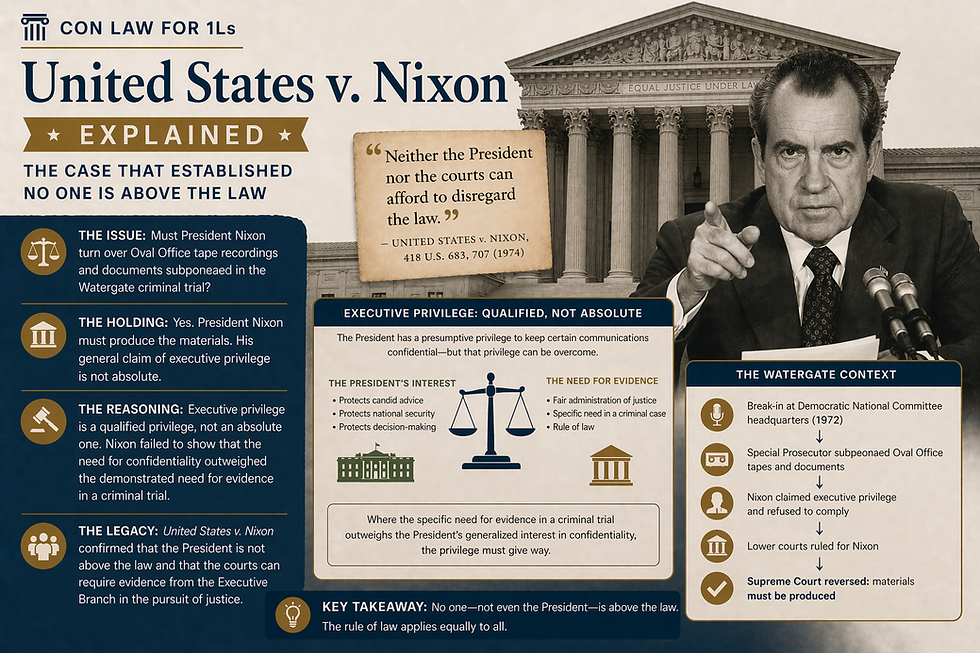
If Youngstown is about the limits of presidential power in an emergency, United States v. Nixon is about the limits of presidential secrecy in a criminal case.
The basic lesson is simple:
The President has executive privilege, but that privilege is not absolute.
That is why United States v. Nixon, 418 U.S. 683 (1974) is one of the core separation-of-powers cases every 1L should know. It is the case that forced President Richard Nixon to comply with a subpoena for the Watergate tapes and helped confirm that even the
President is subject to the rule of law.
This post is part of a Con Law for 1Ls series, so the goal is to make the case clear enough for class, cold calls, outlines, and exams.
The One-Sentence Takeaway
United States v. Nixon held that executive privilege is constitutionally based but qualified, and that a generalized interest in presidential confidentiality must yield to a demonstrated, specific need for evidence in a criminal trial.
That is the short version to remember.
Why Your Professor Cares About Nixon
Your professor is not assigning Nixon just because it is historically dramatic. The real reason is that the case asks a major constitutional question:
Can the President refuse to comply with a judicial subpoena by asserting executive privilege?
The Court’s answer was:
Not absolutely.
That makes Nixon essential for understanding:
executive privilege,
separation of powers,
judicial review,
criminal process,
and the rule of law.
The Facts You Actually Need to Know
Here is the short 1L version.
During the Watergate investigation, a federal grand jury indicted several officials connected to President Nixon’s administration. The Special Prosecutor sought tape recordings and documents of conversations between Nixon and his advisers.
A federal district court issued a subpoena requiring the President to produce the tapes.
Nixon refused, claiming executive privilege and arguing that presidential communications were confidential.
The Supreme Court had to decide whether that privilege allowed Nixon to withhold the tapes from a criminal proceeding.
The Big Question
The main issue was:
Does executive privilege allow the President to refuse to produce subpoenaed evidence needed for a criminal trial?
The Supreme Court said no, at least where the privilege claim is only a generalized claim of confidentiality and not based on military, diplomatic, or national security secrets.
The Holding
Here is the clean holding:
A generalized claim of executive privilege must yield to the demonstrated, specific need for relevant evidence in a pending criminal trial. See United States v. Nixon.
That is the core doctrine.
What Is Executive Privilege?
Executive privilege is the President’s asserted authority to keep certain executive branch communications confidential.
The idea is that Presidents need candid advice from advisers. If every conversation could easily become public, advisers might be less honest or less direct.
The Court recognized that this confidentiality interest is real and constitutionally grounded in the separation of powers. See Nixon.
But the Court also said that the privilege is not absolute.
Why the Privilege Was Not Absolute
The Court recognized the importance of presidential confidentiality, but it balanced that interest against another constitutional value:
the need for evidence in the fair administration of criminal justice.
The Court emphasized that criminal trials depend on access to relevant evidence. If the President could withhold evidence based only on a broad, generalized claim of confidentiality, the judicial process could be seriously impaired.
So the Court rejected an absolute privilege.
The Key Distinction: General Confidentiality vs. National Security
This distinction is very important.
The Court did not say that every claim of executive privilege will fail.
Instead, it said Nixon’s claim was based on a generalized interest in confidentiality.
The Court specifically noted that the case did not involve a claim that the tapes contained:
military secrets,
diplomatic secrets,
or sensitive national security information.
That matters because courts often give much greater deference to the executive in those areas. See Nixon.
So the rule is not “executive privilege never works.” The rule is that a generalized confidentiality claim may yield to a specific need for evidence in a criminal trial.
The Role of Marbury
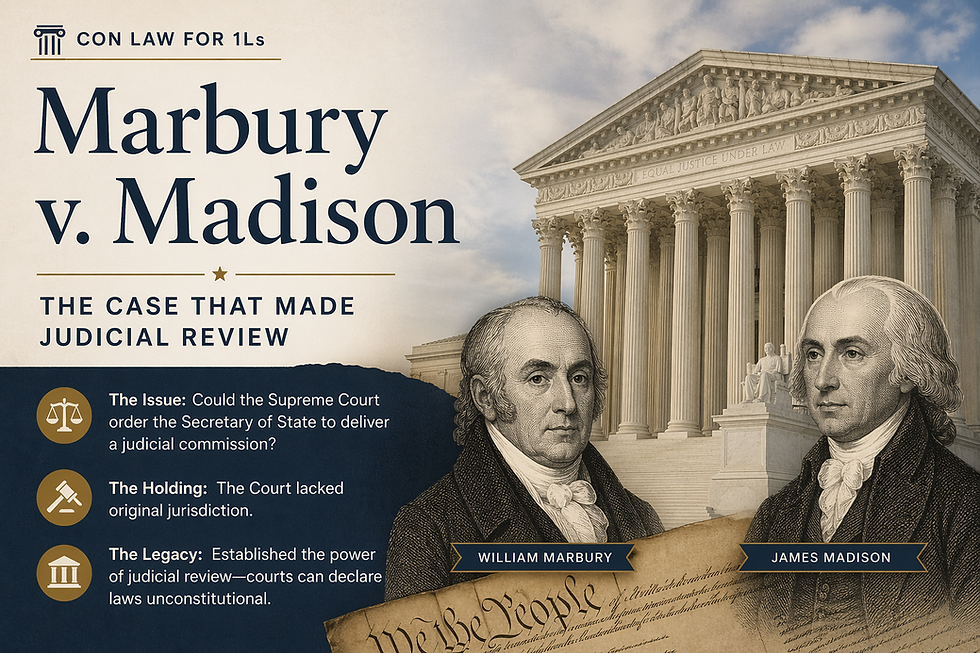
Like many major separation-of-powers cases, Nixon reaches back to Marbury v. Madison.
The Court reaffirmed that it is the duty of the judiciary to say what the law is. That means the President does not get the final word on the scope of executive privilege.
Courts can review the claim and decide whether the privilege applies. See Marbury v. Madison, 5 U.S. 137 (1803); Nixon.
That is a big structural point.
The Role of Youngstown
Nixon also fits naturally with Youngstown.
Both cases reject broad claims of unilateral presidential authority:
Youngstown: the President cannot seize steel mills without legal authority.
Nixon: the President cannot unilaterally define the scope of executive privilege and block criminal evidence.
Together, they show that separation of powers does not mean the President is above judicial review.
The Key Rule in 1L Terms
Here is the exam-friendly rule statement:
Executive privilege is a qualified privilege. When the President asserts only a generalized interest in confidentiality, that interest must yield to a demonstrated, specific need for relevant evidence in a criminal proceeding.
That is the rule most 1Ls should have in their outline.
Why the Court Ordered In Camera Review
The Court did not simply order the tapes released directly to the public.
Instead, it approved in camera review, meaning the district court would examine the materials privately to determine what was relevant and admissible.
That protected two interests at once:
the President’s legitimate confidentiality interest, and
the judicial system’s need for evidence.
This is a good example of the Court balancing institutional interests rather than simply ignoring one branch’s concerns.
The Cold-Call Version
If your professor asks, “What is United States v. Nixon about?” you can say:
United States v. Nixon held that executive privilege exists but is not absolute. A generalized claim of presidential confidentiality must yield to a specific need for relevant evidence in a criminal trial, and courts have authority to review the privilege claim.
That is a strong cold-call answer.
Why Nixon Matters for the Rule of Law
The symbolic importance of Nixon is enormous.
The case stands for the proposition that:
No person, not even the President, is above the law.
That does not mean the President is treated exactly like an ordinary person in every context. The Court expressly recognized the unique role of the presidency and the need to protect presidential communications.
But it does mean the President cannot use generalized confidentiality to defeat the fair administration of criminal justice.
That is the heart of the case.
Common 1L Mistakes About Nixon
Mistake #1: Thinking executive privilege does not exist
Wrong. The Court recognized a constitutionally based privilege for presidential communications.
Mistake #2: Thinking executive privilege always loses
Also wrong. The privilege is qualified, and stronger claims may exist for military, diplomatic, or national security matters.
Mistake #3: Forgetting the criminal-trial context
The specific need for evidence in a criminal trial is central to the holding.
Mistake #4: Treating this as only a Watergate case
The Watergate facts are important, but the doctrinal issue is broader: the balance between executive confidentiality and judicial process.
Quick IRAC for Your Outline
Issue
Can the President refuse to comply with a subpoena for evidence in a criminal case by asserting executive privilege?
Rule
Executive privilege is constitutionally based but qualified. A generalized claim of confidentiality must yield to a demonstrated, specific need for relevant evidence in a criminal trial. See Nixon.
Application
President Nixon asserted a broad confidentiality privilege over subpoenaed tapes. The claim did not rest on military, diplomatic, or national security secrets. The Special Prosecutor showed a specific need for the evidence in a pending criminal case.
Conclusion
The privilege yielded, and the tapes had to be produced for in camera review.
What to Put in Your Case Brief
If you are briefing Nixon for class, include:
Facts: Special Prosecutor subpoenaed Nixon’s Watergate tapes
Issue: does executive privilege allow the President to withhold the tapes?
Holding: no, not on a generalized confidentiality claim in a criminal case
Reasoning: executive privilege exists but is qualified; criminal justice requires access to relevant evidence
Key doctrine: qualified executive privilege
Procedure: in camera review by the district court
Big theme: rule of law and separation of powers
That is enough for most 1L purposes.
Why Nixon Still Matters Today
Nixon remains central whenever courts confront questions about:
executive privilege,
presidential subpoenas,
separation of powers,
criminal process,
and judicial review of presidential claims.
Later cases involving presidential immunity and executive branch confidentiality continue to distinguish or rely on Nixon depending on the context. See, for example, Cheney v. United States District Court, 542 U.S. 367 (2004), which discussed executive branch confidentiality concerns in civil discovery.
How Nixon Fits with the Earlier Cases
By this point, your separation-of-powers arc looks like this:
Marbury: courts say what the law is
Youngstown: presidential power has limits
Nixon: executive privilege exists, but it is not absolute
Baker: some issues are political questions, but courts still decide many major constitutional disputes
NFIB: federal power may survive under one constitutional clause even if it fails under another
Nixon is one of the best cases for seeing how the Court balances respect for the presidency with the judiciary’s duty to administer justice.
Final Takeaway for 1Ls
If you remember nothing else, remember this:
United States v. Nixon says that executive privilege is real, but a generalized claim of presidential confidentiality cannot overcome a specific need for evidence in a criminal trial.
That is why the case matters so much.
The Watergate tapes were the vehicle.The real subject was whether the President is
subject to judicial process.
And that is why United States v. Nixon, 418 U.S. 683 (1974) is one of the core Con Law cases every 1L should know.

Comments