Con Law for 1Ls: Marbury v. Madison Explained

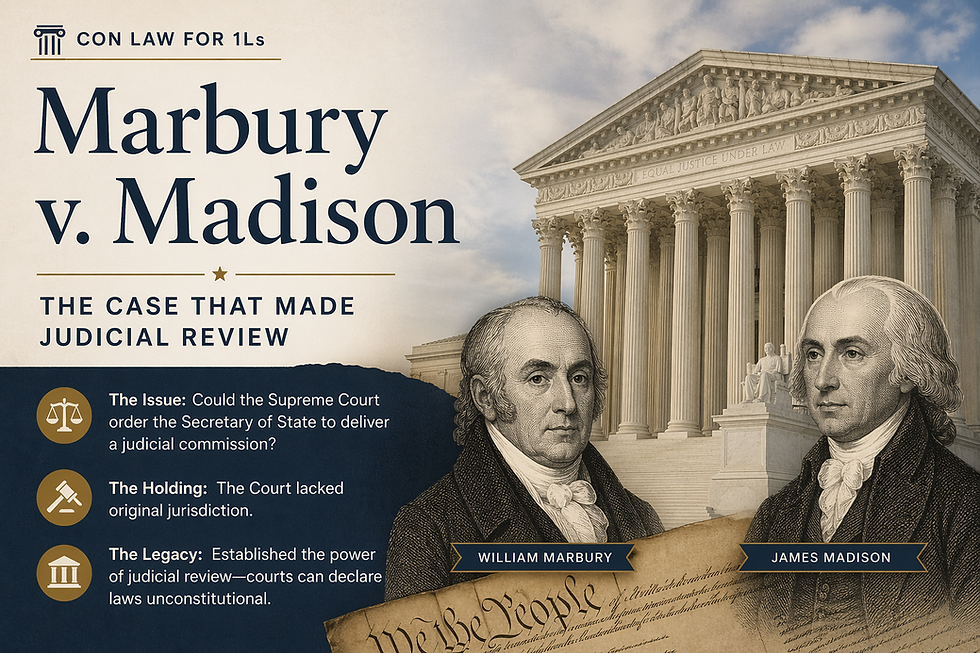
If you are a 1L in Constitutional Law, there are a few cases you absolutely need to know cold. Marbury v. Madison is one of them.
In fact, it may be the case your professor uses to introduce the role of the Supreme Court in the constitutional system.
Why? Because Marbury v. Madison, 5 U.S. 137 (1803) is the case that gave us the foundational idea of judicial review: the power of courts to refuse to enforce laws that conflict with the Constitution.
This post is part of a Con Law for 1Ls series, so the goal is simple: help you understand the case the way you need to understand it for class, cold calls, outlines, and exams.
The One-Sentence Takeaway
Marbury v. Madison established that the Supreme Court has the authority to declare an act of Congress unconstitutional, and that Congress cannot expand the Supreme Court’s original jurisdiction beyond Article III.
If you can say that clearly, you already have the core of the case.
Why Your Professor Cares About Marbury
Your professor is not assigning Marbury because of the dispute over one man’s commission. The real reason is that the case helps answer a much bigger question:
Who decides what the Constitution means when a statute conflicts with it?
Marshall’s answer: the judiciary does.
That is why Marbury is usually the starting point for discussions of:
judicial review
Article III judicial power
separation of powers
the role of courts in constitutional interpretation
The Facts You Actually Need to Know
Here is the version you need for class.
At the end of John Adams’s presidency, the outgoing Federalist administration rushed to fill judicial positions before Thomas Jefferson took office. These were the famous “midnight appointments.”
William Marbury was appointed as a justice of the peace in the District of Columbia.
What happened next:
Adams nominated Marbury.
The Senate confirmed him.
Marbury’s commission was signed.
The commission was sealed.
But it was not delivered before Jefferson took office.
Jefferson told his Secretary of State, James Madison, not to deliver it.
Marbury then asked the Supreme Court to issue a writ of mandamus ordering Madison to hand over the commission.
That request set up the case.
Vocabulary Check: What Is a Writ of Mandamus?
A writ of mandamus is a court order telling a government official to perform a legal duty.
For 1L purposes, think of it this way:
If an official has discretion, courts usually cannot tell them how to exercise it.
If an official has a specific ministerial duty, a court may be able to order performance.
That distinction becomes important in Marbury because Marshall says the delivery of the commission is a ministerial act, not a discretionary political one.
The Three-Part Framework You Should Memorize
Marshall organizes the opinion around three questions. This is the easiest way to brief the case and the easiest way to remember it.
1. Did Marbury have a right to the commission?
Yes.
Marshall says the appointment was complete once the President signed the commission and the seal was affixed. At that point, Marbury had a vested legal right to the office. See Marbury v. Madison.
2. If he had a right, did the law give him a remedy?
Yes.
Marshall says that where there is a legal right, there is generally a legal remedy. He emphasizes that the United States is a government of laws, not of men. If an executive officer violates a vested legal right, the courts can ordinarily provide relief. See Marbury.
3. Was the remedy available from the Supreme Court in this case?
No.
This is where everything turns.
Marshall concludes that although Marbury had a right, and although mandamus would ordinarily be the proper remedy, the Supreme Court lacked jurisdiction to issue the writ in this case.
So Why Did Marbury Lose?
Because of jurisdiction.
Marbury relied on section 13 of the Judiciary Act of 1789, which appeared to authorize the Supreme Court to issue writs of mandamus to federal officers.
But Article III of the Constitution gives the Supreme Court limited original jurisdiction, and Marshall said this case did not fit within those categories.
So if section 13 really gave the Court original jurisdiction here, it would conflict with Article III.
And when a statute conflicts with the Constitution, the Constitution wins.
That is the key move in the case.
The Big Holding
Here is the holding in cleaner 1L language:
The Supreme Court could not issue Marbury’s requested writ because Congress cannot enlarge the Supreme Court’s original jurisdiction beyond what Article III permits.
That is the narrow holding.
But the broader constitutional principle is even more important:
It is the role of the judiciary to interpret the law and to refuse effect to statutes that are repugnant to the Constitution.
That is judicial review.
What Is Judicial Review?
Judicial review is the power of courts to decide whether legislative or executive acts are consistent with the Constitution.
In Marbury, Marshall reasons that:
the Constitution is the fundamental law;
ordinary legislation cannot override it; and
courts must decide which rule governs when the Constitution and a statute conflict.
That is why the case is so famous. It is the canonical source for the idea that courts can strike down unconstitutional laws. See Marbury.
Modern Supreme Court cases still treat Marbury as foundational to the judicial role. See, e.g., Kisor v. Wilkie, 139 S. Ct. 2400 (2019).
The Classic Cold-Call Question: If Marbury Won So Much, Why Did He Still Lose?
Because Marshall gives Marbury:
a right, and
a theory of remedy,
but then denies him relief because the Court cannot constitutionally act.
That is what makes the opinion so strategic.
Marbury wins the first two steps:
Yes, you were appointed.
Yes, the law was violated.
But he loses the third:
No, this Court cannot issue the writ.
So the Court looks principled, criticizes the Jefferson administration, and avoids issuing an order the executive might ignore.
Meanwhile, Marshall establishes judicial review.
That is why people often say Marbury is as much about institutional power as it is about doctrine.
Why Marshall’s Opinion Is So Smart
This is one of the reasons professors love this case.
Marshall manages to:
Call out the executive branch
He says Madison’s refusal to deliver the commission violated a vested legal right.
Avoid direct conflict with Jefferson
If the Court had ordered Madison to deliver the commission, Jefferson might have refused. That could have weakened the Court.
Strengthen the judiciary
By declaring part of the Judiciary Act unconstitutional, Marshall positions the Court as the final interpreter of constitutional limits in cases before it.
In other words, Marbury lost the commission, but the Court gained long-term authority.
The 1L Exam Rule
If you need a compact rule statement for your outline, use this:
Under Marbury v. Madison, it is the duty of the judiciary to interpret the law and apply the Constitution over conflicting statutes. Congress may not expand the Supreme Court’s original jurisdiction beyond Article III.
That is a strong exam-ready version.
What Your Professor Wants You to Notice
When Marbury comes up in class, your professor is probably looking for more than “this is the case that created judicial review.”
They usually want you to see at least four things:
1. The difference between merits and jurisdiction
A party can be right on the merits and still lose because the court lacks power to act.
2. The difference between political and ministerial acts
Courts generally will not review discretionary executive decisions, but they may review failure to perform a specific legal duty.
3. The constitutional status of the judiciary
Marshall is arguing that judges must interpret and apply the Constitution because that is inherent in deciding cases.
4. The strategic dimension of judicial opinions
This is not just a legal opinion. It is also an institutional move by the Court.
Common 1L Mistakes About Marbury
Here are a few easy traps to avoid.
Mistake #1: Saying the case was only about judicial review
That is the big takeaway, but the opinion is also about Article III jurisdiction and remedies.
Mistake #2: Forgetting the three-step structure
The opinion works because Marshall separates:
right,
remedy,
jurisdiction.
If you collapse those together, the case gets confusing.
Mistake #3: Saying Marbury won
He did not. He won important points in the reasoning, but he lost the case because the Court would not issue the writ.
Mistake #4: Treating mandamus as the main point
Mandamus matters, but only as the procedural vehicle. The real significance is the Court’s assertion of constitutional interpretive power.
Quick IRAC for Your Outline
Issue
Can the Supreme Court issue a writ of mandamus ordering Secretary of State James Madison to deliver William Marbury’s commission?
Rule
The Supreme Court has only the original jurisdiction granted by Article III, and Congress cannot expand it by ordinary statute. Courts must apply the Constitution over conflicting legislation. See Marbury.
Application
Marbury had a vested legal right to the commission, and mandamus would ordinarily be an appropriate remedy for the refusal to perform a ministerial duty. But section 13 of the Judiciary Act of 1789, if read to authorize the Supreme Court to issue the writ in original jurisdiction, conflicted with Article III.
Conclusion
The Court could not grant the writ, and the conflicting statutory grant was unconstitutional.
What to Put in Your Case Brief
If you are briefing the case for class, make sure your brief includes:
Facts: Adams appointed Marbury; Madison would not deliver commission.
Procedural posture: Marbury sought mandamus in the Supreme Court.
Issue: Could the Court issue the writ?
Holding: No, because Congress cannot enlarge the Court’s original jurisdiction beyond Article III.
Reasoning: Constitution is superior to statutes, and courts must apply it.
Key doctrine: Judicial review.
That is enough for most cold calls.
Final Takeaway for 1Ls
If you remember nothing else, remember this:
Marbury v. Madison is not just the case about the undelivered commission. It is the case about why courts get to say what the law is when the Constitution and a statute conflict.
That is why it sits at the center of Constitutional Law.
Marbury asked for a commission.Marshall used the case to define the judicial power.
And that is why Marbury v. Madison, 5 U.S. 137 (1803) is one of the first cases every 1L needs to understand.


Comments