Con Law for 1Ls: Martin v. Hunter’s Lessee Explained

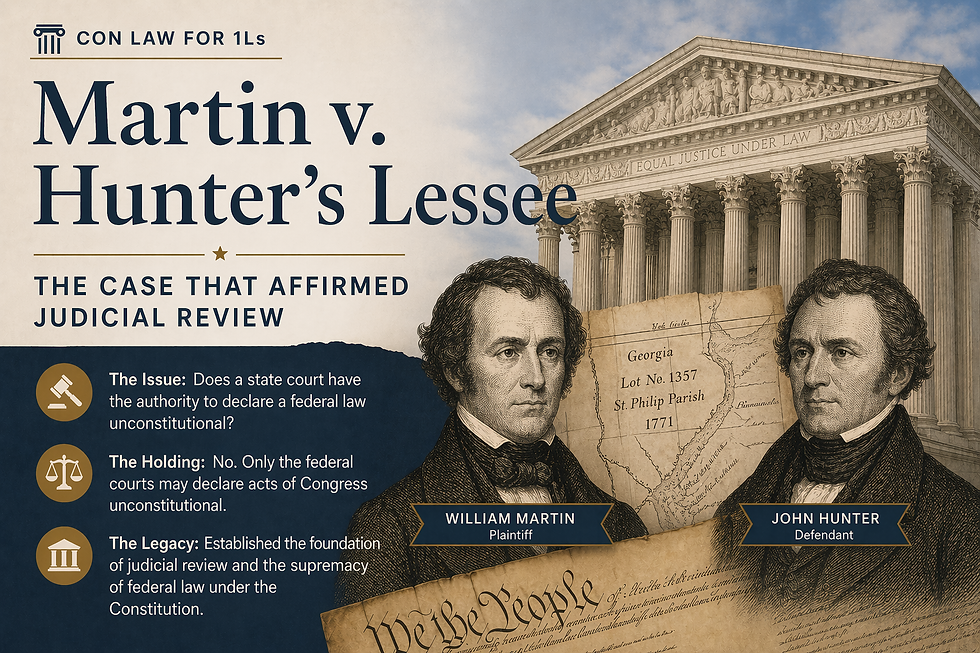
If Marbury v. Madison is about judicial review, and McCulloch v. Maryland is about federal power, then Martin v. Hunter’s Lessee is about who gets the final word on federal law.
And the answer is: the U.S. Supreme Court does.
That is why Martin v. Hunter’s Lessee, 14 U.S. 304 (1816) is a foundational case in Constitutional Law and Federal Courts. It establishes that the Supreme Court may review state-court decisions on federal questions.
This post is part of a Con Law for 1Ls series, so the goal is to make the case clear enough for class, cold calls, outlines, and exams.
The One-Sentence Takeaway
Martin v. Hunter’s Lessee held that the Supreme Court has constitutional authority to review state-court judgments on questions of federal law, in order to ensure the uniform interpretation and supremacy of federal law.
If you can say that cleanly, you already have the core of the case.
Why Your Professor Cares About Martin
Your professor is not assigning Martin because of a land dispute. The real reason is that the case answers a structural question at the heart of the Constitution:
Can state courts have the last word on federal law?
Justice Story’s answer was no.
If state supreme courts could conclusively interpret the Constitution, treaties, and federal statutes for themselves, then federal law could mean one thing in Virginia, another in New York, and something else in Massachusetts.
That would be a disaster for a national legal system.
So Martin is really about:
Supreme Court review of state courts
federal uniformity
Article III judicial power
and the supremacy of federal law
The Facts You Actually Need to Know
The facts are old and a little messy, but here is the version you need for class.
The dispute involved land in Virginia that had once belonged to Lord Fairfax, a British subject. During and after the Revolutionary War, Virginia enacted laws affecting the property rights of British loyalists and British nationals.
Denny Martin, who claimed through Lord Fairfax, argued that his title was protected by federal law—specifically treaties between the United States and Great Britain.
Hunter’s Lessee claimed the land under Virginia law.
So the case became a conflict between:
state law and state court judgment, and
federal treaty rights
The Virginia Court of Appeals ruled against the federal claim. The U.S. Supreme Court reversed once. But Virginia’s court then pushed back and basically argued that the
Supreme Court had no authority to review its judgment.
That is what made the case so important.
The Big Question
Here is the core issue:
Does the U.S. Supreme Court have appellate jurisdiction to review final decisions of state courts when those decisions turn on federal law?
Justice Story said yes.
Why This Was Even a Question
At first glance, some students think the answer should be obvious. Article III creates the Supreme Court, federal law is supreme, so of course the Court can review state courts.
But for early Americans, this was controversial.
The Virginia court argued that state courts were independent and that the Supreme Court could not sit above them in this way.
That raised a deep federalism concern:
Are state courts final within their own sovereign sphere?
Or does the national judiciary have authority to correct them on federal questions?
Martin answers that the national judiciary must have that authority.
The Holding
Here is the clean holding:
The Supreme Court may review state-court judgments in cases involving the Constitution, federal laws, and treaties, and Congress may authorize that review through the Judiciary Act. See Martin v. Hunter’s Lessee.
That is the central rule you need.
Why Story Said Supreme Court Review Was Necessary
Justice Story gave several reasons.
1. Article III extends federal judicial power to all cases arising under federal law
Story emphasized that Article III extends the judicial power of the United States to all cases arising under the Constitution, laws, and treaties of the United States.
That matters because the text focuses on the nature of the case, not the identity of the court that first hears it.
So if a case involves a federal question, Article III allows the federal judicial power to reach it. See Martin.
2. State courts will often decide federal issues first
Story recognized a practical point: many federal questions arise in ordinary litigation in state courts.
If the Supreme Court could not review those decisions, then a huge body of federal law would escape national judicial supervision.
That would undermine the federal system.
3. Uniformity matters
One of Story’s biggest concerns was uniformity.
If each state court could interpret federal law for itself without Supreme Court review, the Constitution, treaties, and federal statutes would mean different things in different states.
That would defeat the idea of national law.
This concern about uniformity is one of the most important themes in the case and one of the reasons professors keep assigning it.
4. Federal law must be supreme
The Supremacy Clause means federal law is binding on the states. But that supremacy would be weakened if state courts had unreviewable authority to define federal law differently from one another.
So Story treats Supreme Court review as part of the structure that makes federal supremacy real.
The Key Rule in 1L Terms
Here is the exam-friendly version:
The Supreme Court has appellate jurisdiction over state-court judgments that decide federal questions, because Article III extends the federal judicial power to all such cases and national uniformity requires a final federal tribunal.
That is the rule statement most 1Ls should have in their outline.
What Martin Is Really About
On the surface, the case is about land.
In doctrine, it is about Article III appellate jurisdiction.
But at its core, it is about this:
Federal law cannot be supreme unless there is a final national court with power to ensure that supremacy.
That is the big idea.
The Relationship Between State Courts and Federal Courts
One of the most important lessons from Martin is that state courts are not cut off from federal law. In fact, state courts routinely decide federal issues.
But when they do, they are not the final word.
That is the role of the U.S. Supreme Court.
So the case does not mean state courts are irrelevant to federal law. It means that when federal questions are at stake, the constitutional system requires a federal tribunal capable of final review.
Why This Case Matters for Federalism
A lot of 1Ls think federalism cases are only about limits on Congress or state sovereignty. Martin shows that federalism is also about judicial structure.
The case protects national supremacy while still recognizing that state courts are part of the constitutional system.
The balance looks like this:
State courts may hear many federal questions.
But the Supreme Court may review them.
That review preserves the national character of federal law.
So Martin is really a federalism case about judicial hierarchy.
The Cold-Call Version
If your professor asks, “What is Martin v. Hunter’s Lessee about?” you can say:
Martin v. Hunter’s Lessee held that the U.S. Supreme Court can review state-court decisions on questions of federal law because Article III extends federal judicial power to those cases and uniformity requires a final national interpreter.
That is a strong cold-call answer.
Why Martin Still Matters Today
Martin is not just a historical case. Its basic principle still matters because federal questions still arise in state courts all the time.
Modern Supreme Court cases continue to cite Martin for the idea that state courts are bound by federal law and subject to Supreme Court review on federal questions. See, for example, Montgomery v. Louisiana, 577 U.S. 190 (2016), recognizing that states may not disregard controlling constitutional rules in their own courts.
So when you read Martin, you are not reading a dead relic. You are reading part of the architecture of the modern federal judiciary.
Common 1L Mistakes About Martin
Mistake #1: Thinking the case is only about treaties
The treaty issue matters, but the broader significance is about Supreme Court review of state-court federal questions.
Mistake #2: Thinking the Supreme Court can review every state-court issue
Not quite. The key point is review of federal questions.
Mistake #3: Missing the Article III argument
This is not just a policy case about uniformity. Story roots the result in the constitutional grant of judicial power.
Mistake #4: Forgetting the supremacy concern
The case is not just about hierarchy for hierarchy’s sake. It is about making federal law truly supreme.
Quick IRAC for Your Outline
Issue
Can the U.S. Supreme Court review a final state-court judgment that turns on a question of federal law?
Rule
Article III extends the federal judicial power to all cases arising under the Constitution, laws, and treaties of the United States, and Congress may authorize Supreme Court appellate review of state-court decisions involving such questions. See Martin.
Application
Because the dispute involved federal treaty rights, it fell within the federal judicial power. If state courts had unreviewable authority over such issues, federal law would lack uniformity and supremacy.
Conclusion
The Supreme Court could review the Virginia court’s decision.
What to Put in Your Case Brief
If you are briefing Martin for class, include:
Facts: land dispute in Virginia involving federal treaty rights
Issue: can the Supreme Court review state-court federal-question decisions?
Holding: yes
Reasoning: Article III extends to all federal-question cases; uniformity and supremacy require final Supreme Court review
Key doctrine: Supreme Court appellate review over state courts on federal issues
That is enough for most cold calls.
How Martin Fits with Marbury and McCulloch
This is one reason these cases are often taught together.
Marbury: the judiciary can interpret the Constitution
McCulloch: federal power is broad within its constitutional sphere
Martin: the Supreme Court has the final word on federal questions coming out of state courts
Together, these cases help build the structure of national constitutional authority.
If Marbury is about judicial review, and McCulloch is about implied powers, then Martin is about federal judicial supremacy over federal questions.
Final Takeaway for 1Ls
If you remember nothing else, remember this:
Martin v. Hunter’s Lessee says that federal law cannot be uniform or supreme unless the U.S. Supreme Court can review state-court decisions on federal questions.
That is why the case matters so much.
The land dispute was the vehicle.The real subject was who gets the final word on federal law.
And that is why Martin v. Hunter’s Lessee, 14 U.S. 304 (1816) is one of the core Con Law
cases every 1L should know.

Comments